Commercial Solar Panels for Welsh Businesses
Reduce operating costs, fix a meaningful share of your energy bill, and earn money back on surplus generation. Commercial solar PV is one of the few infrastructure investments that genuinely pays for itself within the lifetime of the asset.
We design, install, and commission rooftop and ground-mount solar systems from 30 kW right up to 1 MW and above for businesses across Wales.
System sizes and typical applications
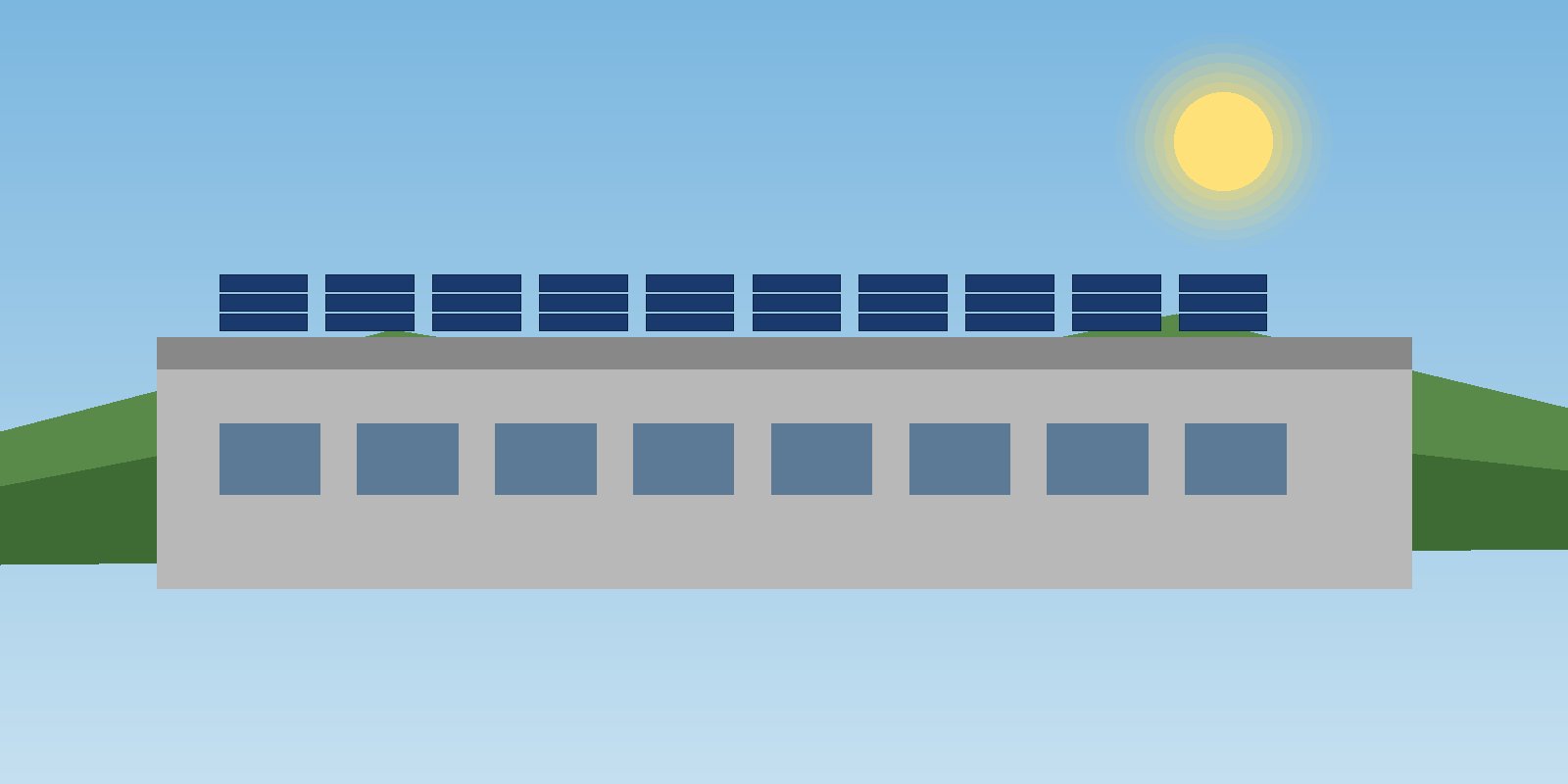
Most of our commercial installations sit between 50 kW and 500 kW, which suits the majority of Welsh business premises. A 50 kW system needs roughly 250 square metres of usable roof and covers typical electricity demand for an SME with daytime operation. A 250 kW system requires around 1,250 square metres and works well for medium-sized manufacturers, larger offices, and food production facilities. Above 500 kW we are usually working with warehouses, large distribution centres, or ground-mount systems on adjoining land.
Every business is different, and the right system size depends as much on your half-hourly consumption profile as it does on available roof space. We always run a detailed match analysis to ensure the array is sized for maximum self-consumption rather than maximum export.
Roof types we install on
We install on virtually every commercial roof construction found in Wales. Profiled metal sheeting, the most common modern industrial roof, is fast and economical to install on using non-penetrating clamp systems. Standing-seam roofs accept clamps without piercing the membrane. Single-ply membrane roofs such as PVC and TPO can take ballasted systems that avoid any penetrations. Built-up felt, asphalt, and EPDM roofs typically need penetrative fixings with proper waterproofing, and we coordinate with the original membrane supplier where required to preserve any existing warranties.
Concrete and slate roofs on older commercial premises, such as Victorian mills and converted warehouses, need a more bespoke approach but are very much within scope. We carry out a full structural assessment as part of every commercial survey.
- Trapezoidal and standing-seam metal roofs
- Single-ply PVC, TPO, and EPDM membrane roofs
- Built-up felt and asphalt flat roofs
- Concrete and slate roofs on heritage commercial buildings
- Ground-mounted arrays on adjoining land
- Solar carport canopies over car parks and yards
Equipment we specify
We work with established Tier 1 module manufacturers including JA Solar, Trina, LONGi, and Jinko, choosing the right panel for each site based on roof orientation, shading characteristics, and cost-per-kWh delivered. For inverters we use Huawei, SolarEdge, SMA, and Fronius depending on system size and monitoring requirements. Mounting systems come from K2, Schletter, Van der Valk, and Esdec, all of which are calculated for wind and snow loads specific to your location in Wales.
We never specify the cheapest components for the sake of margin. Commercial systems are 25-year investments, and the small savings on entry-level equipment are dwarfed by the cost of premature failure, lost generation, and warranty disputes ten or fifteen years down the line.
Financial modelling and case for investment
Before you approve any spend, we provide a clear financial model showing projected generation in kWh, self-consumption percentage, savings against current and forecast tariffs, Smart Export Guarantee income, capital allowances and tax relief, simple payback in years, and internal rate of return over 25 years.
We build these models conservatively, using PVGIS data adjusted for site-specific conditions and realistic degradation assumptions. We would rather under-promise and over-deliver than show you optimistic numbers that fail to materialise.
Frequently asked questions
What is the smallest commercial system you install?
We typically start at around 30 kW, which suits small business premises and rural offices. Below that, a domestic-sized installation may be more cost-effective and still qualifies for capital allowances if installed on commercial premises.
Do we need planning permission for a commercial solar installation?
Most rooftop installations on industrial and commercial buildings fall under permitted development rights and do not need planning permission. Ground-mounted systems above 1 MW and installations on listed buildings or within conservation areas typically do. We handle all planning queries as part of our service.
How is exported electricity metered?
A commercial installation typically uses a half-hourly export meter, which records exported generation in 30-minute increments. Your energy supplier reads this remotely. Smart Export Guarantee payments are made monthly or quarterly depending on the supplier.
Can the system be expanded in future?
Yes, we design with future expansion in mind where roof or land area allows. The inverter is often sized to accept additional strings, and switchgear is specified for the anticipated final capacity even if the initial deployment is smaller.
Commissioning, monitoring, and long-term performance
Once the modules are installed, the inverters wired in, and the DC and AC sides safely connected, we move to commissioning. This is a structured set of tests that verifies every electrical connection, every isolation point, and every safety function before the system is energised. We use insulation resistance testers, earth loop testers, and infrared cameras to identify any installation defects before the system goes live, and we record the readings in a witness pack that becomes part of your handover documentation.
Every commercial system we install is connected to remote monitoring as standard. This gives you, your facilities team, and our service team continuous visibility of generation, individual string performance, inverter health, and any fault conditions. Most issues, when they occur, are detected by the monitoring platform before they would be noticed by site staff, and many can be diagnosed and resolved remotely without a visit.
Ongoing operations and maintenance
Although solar PV is a relatively low-maintenance technology, periodic inspection and cleaning is sensible to keep generation at its peak. We offer optional service-level agreements that cover annual electrical inspection, panel cleaning where access permits, inverter firmware updates, monitoring management, and priority response for any fault. The annual cost of a service agreement is typically less than 1% of the original system value, and the additional generation it secures usually more than covers the cost.